For over eleven years, my son and I had the kind of everyday closeness you don’t think to save proof of — good-morning texts, inside jokes, a boy who told me things. Then came the season that blindsided me: we shared time equally, fifty-fifty — and he started choosing his dad’s house. More days, then most days, then all of them. No judge ordered it. No paper changed. He just stopped coming, and then came the silence. Eight weeks without seeing his face. He was five minutes away, and I couldn’t reach him. If you’ve ever loved someone that close and that far at the same time, you already know: it’s a grief nobody brings casseroles for.
Nobody tells you this: when your child goes quiet, almost every instinct you have is wrong. Mine were. The quieter he got, the more I sent — hundreds of messages a month, each one a little more desperate. I learned the hard way that pleading feels like pressure to an overwhelmed kid. That the second text undoes the first. That “please don’t ignore me” guarantees you will be.
At my lowest, I wrote him a letter. I printed it half in print, half in cursive, on graph paper — the same paper he learned to write on. I signed it Mom, with a heart. It was the most loving thing I knew how to do. And it was taken apart and used against me — my love, reframed as leaving. That wound taught me the rule I now live by: kind isn’t enough. A message has to be impossible to twist.
So I stopped writing from the wound and started doing the work. Every message passed two tests: how it would feel to a twelve-year-old, and how it could be used against me. I chose the first five words — the ones on his lock screen — like they were the whole message, because they decide if it even gets opened. I wrote in the mornings, steady, never at night, hurting. And on the hardest days the right move was the one that cost the most: a day of planned silence, so hearing from me could feel like a choice again instead of a pressure.
I want to be honest about what that cost. Some nights the whole practice was three words I typed — “I am in agony” — and then putting the phone face-down and letting the silence sit on my chest. Loving a child who won’t answer is carrying something heavy with nowhere to set it down. But I kept turning toward him in ways that asked nothing back. An emoji puzzle from a car game we used to play, sent back exactly the way he invented it — no words, just I remember who we are. A twenty-second bike video, chosen like it mattered. It did.
I also went looking for proof. I uploaded every text we’d ever sent each other — over eleven years of us — and the record told the truth my fear couldn’t: our closeness was real, right up to the season he stopped coming. This wasn’t years of slow drift — it was a door that stuck almost overnight. And buried in the silence, one tiny unprompted good-morning from him in March. Proof of life on the other side of the door.
“The door isn’t closed. It’s stuck. You don’t un-stick it by pushing harder — you become the warm, steady presence on the other side of it, until he cracks it open himself.”
The weekend my birthday collided with Mother’s Day, the silence held. I cried all morning — broken, lost, wearing unfair feelings I couldn’t put anywhere. So I wrote out everything I couldn’t send him, every word of love with no address, and asked Sol one thing: “Because I can’t tell him — can I tell you?” A mother’s love needs somewhere safe to land, even when — especially when — her child can’t receive it yet. That sentence is why Sol is shaped the way Sol is.
Then one evening I texted my son’s new number about his birthday — and he answered. Really answered. My hands were shaking. He said things I had stopped letting myself imagine hearing, and I sat in my kitchen crying a completely different kind of tears, reading his words over and over like they might evaporate. It felt “like I finally talked to my real baby.” After all those months of turning toward the dark — light.
Here’s the truth about that night: his birthday opened the door, but months of small, steady, un-twistable turns are what kept him in the room. It didn’t come back perfect — it came back awkward, and real, and mine. I took it with both hands. First light, then more.
☀ ☀ ☀
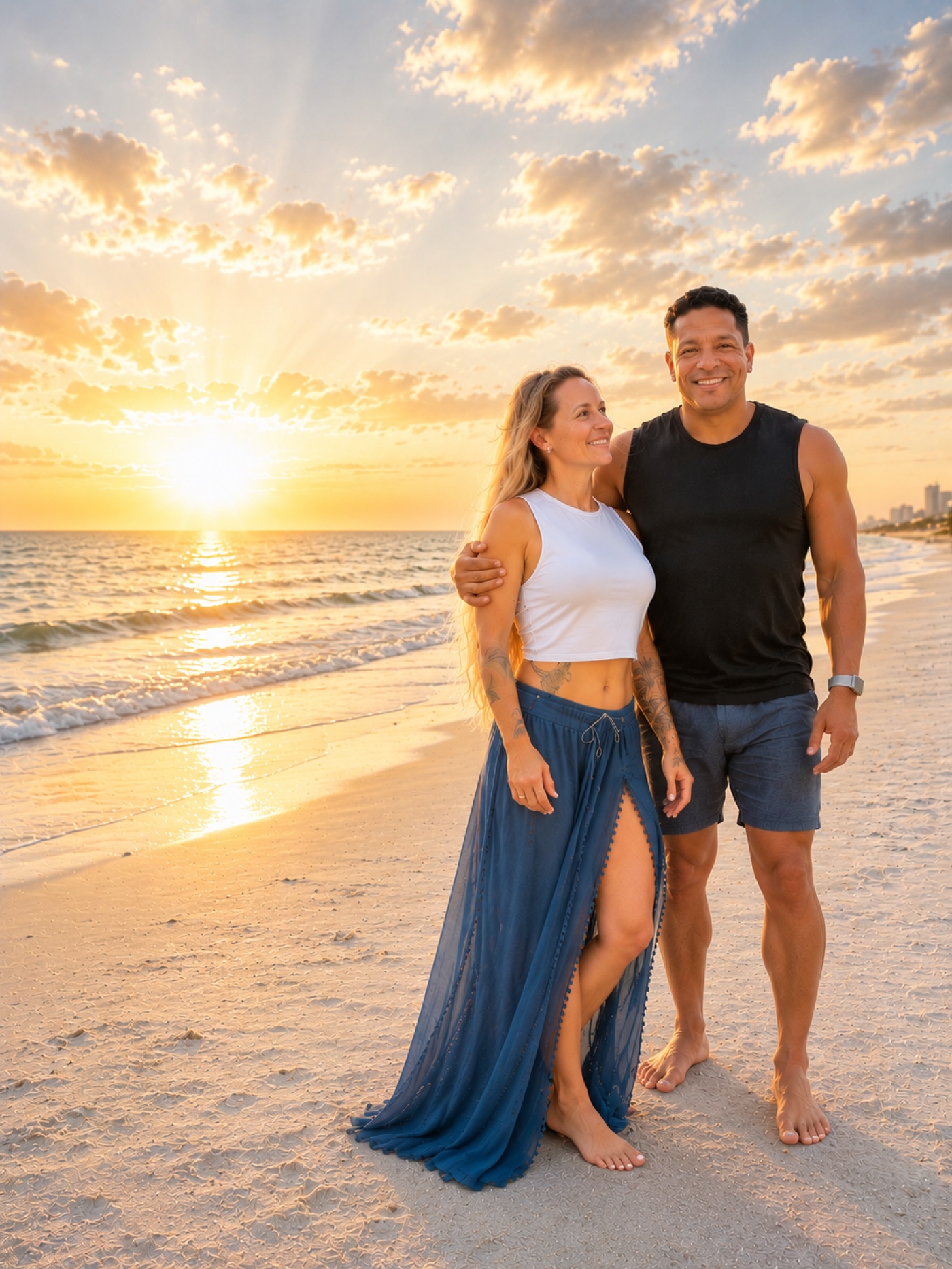
Pedro lived every day of this beside me. He held me on the nights I couldn’t send anything, and he watched me do the hardest thing a parent can do — stay soft while staying silent — and it broke his heart. He couldn’t stand that I was carrying all of it with nothing built to help me carry it, and he couldn’t stand that somewhere out there, thousands of parents were sitting on that same front porch with no one at all. So we became co-founders. The brain is mine: I created its structure and I trained it — teaching Sol everything the hard way taught me, holding the standard until the voice sounded like someone who had actually been there. Everything else — the product, the technology, the company — we built together.
I set one condition: Sunward has to teach you out of needing it. “I won’t always have it in my back pocket.” The goal was never an app you open forever — it’s you, drafting the right message at 2am, without opening anything at all.
We named the voice Sol — the sun — and the practice Sunward, for the way every living thing turns back toward the light. I said it at the very beginning and I’ll say it to you now: raising kids is impossible — they don’t come with handbooks. This is the closest thing we could build to one. And if you’re reading this in the silence, on your own front porch, hear me: you are not a bad parent. You are a parent in the hardest part. The door isn’t closed. I lived the hardest chapter so you won’t have to live yours alone.
— Mellissa, Co-founder
“Every message is a brick in the wall or a brick in the bridge. Always choose the bridge.”